Bromley and London, 1866–1946
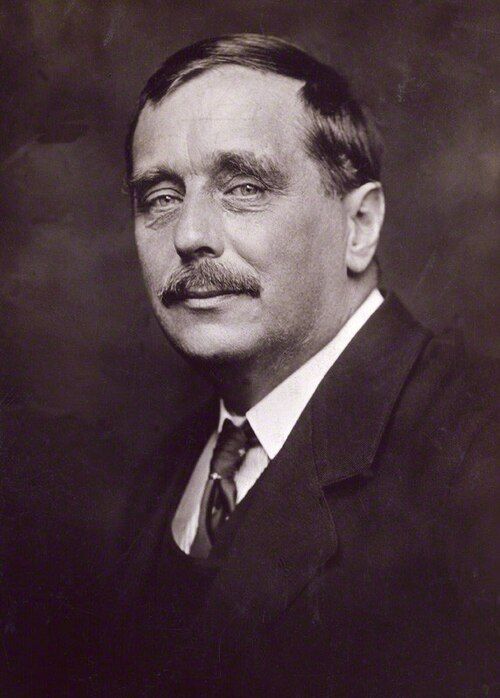
H. G. Wells
Wells did not invent the idea of travelling in time, but he invented the machine. His Time Traveller explains to his dinner guests that time is simply a fourth dimension, and then sets off along it.
The view
The Time Machine (1895) opens with an argument. The Time Traveller tells his guests that a real cube must have duration as well as length, breadth and thickness, and that time is a fourth dimension. "There is no difference between Time and any of the three dimensions of Space," he says, "except that our consciousness moves along it." If we can move freely in space, why not in time? His machine, a thing of nickel, ivory and quartz, has two levers, one to send it forward and one back.
He travels to the year 802,701, where the gentle Eloi live above ground and the Morlocks, who feed on them, below; then on, thirty million years and more, to a dim red sun over a dying shore; and then home, to arrive in time for dinner with his story. He sets off again and does not return.
The argument
Wells's argument is an analogy: time is a dimension like the others, so a machine could move along it. The analogy is the start of the modern subject, and it hides the first puzzle. To move along a dimension is to be at different places at different times. What would it be to be at different times at different… times? The traveller's own experience must supply a second time, against which the motion through the first is measured.
Where he meets Deutsch
Deutsch's chapter begins exactly where Wells did, with the thought that if time is a fourth dimension, travelling in it might be like travelling in space. And Deutsch's definition of time travel keeps what is right in Wells's picture: two measures of time that come apart, the calendar outside and the traveller's own.
Where he parts from Deutsch
Deutsch rejects the rest. On his account nothing moves through time, so the Traveller's machine, which slides along the years like a carriage, describes nothing that could happen. A real time machine would not be a vehicle but a place or a path, and it could reach back only to times at which it already existed: no machine could take its builder to before it was built, as Wells's goes back to the dawn of the earth. And Wells's Traveller never meets himself, never changes anything, never brings back a book he should not have. The paradoxes that the rest of the subject is about never come up.
| Wells | Deutsch | |
|---|---|---|
| Is travel into the past possible? | Yes. The machine travels along time in either direction, as a vehicle travels through space. | Not yet known. General relativity allows closed timelike curves; whether the full laws of physics do waits on a quantum theory of gravity. |
| What happens if you try to change the past? | Not considered. The Traveller returns to his own time without meeting himself or altering anything. | You cannot change your own past, because you never arrive in it. In the past you do reach, you can do as you choose, and history there goes differently. |
| Where does the traveller arrive? | In his own history, at the date the dials show. | In another universe of the multiverse, at an earlier time: a past that differs from your own from the moment you arrive. |
| What resolves the paradoxes? | The story raises none. | Quantum theory applied to the loop. The multiverse as a whole is always consistent, and any knowledge a traveller brings was created by someone. |
Further reading
- H. G. Wells, The Time Machine (1895). Short, and free to read online.
- Paul J. Nahin, Time Machines: Time Travel in Physics, Metaphysics, and Science Fiction (1993; 2nd edn 1999), which traces the idea from Wells to the physicists.
- James Gleick, Time Travel: A History (2016).