Röcken, Basel and Sils Maria, 1844–1900
Friedrich Nietzsche
Nietzsche imagined a demon who tells you that you will live your life again, and again, exactly as you have lived it. It is the oldest modern picture of time turning back on itself, and no one in it travels at all.
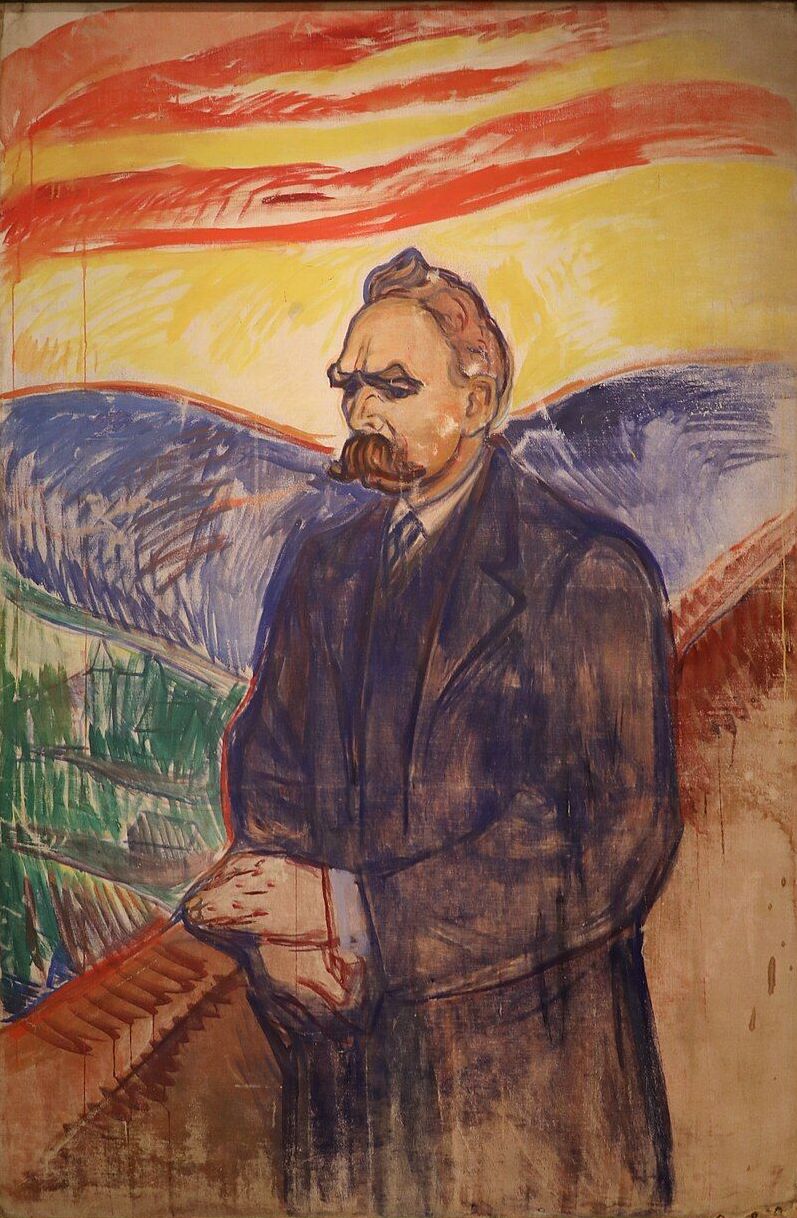
The view
In section 341 of The Gay Science (1882), titled "The Greatest Weight", Nietzsche asks the reader to imagine a demon creeping into their loneliest hour. The demon says that the life you are living you will have to live again, innumerable times, with nothing new in it: every pain and every joy, every thought and sigh, in the same order, even this spider and this moonlight between the trees, and this moment, and the demon itself. Would you throw yourself down and curse him? Or have you known a moment in which you would answer that you had never heard anything more divine?
The thought returns in Thus Spoke Zarathustra (1883–85), where Zarathustra stands at a gateway called "Moment", from which two endless roads run, one back and one forward, and asks whether everything that can happen must not already have happened, and must not come round again.
The argument
Nietzsche's notebooks toyed with a cosmological argument: if the world has a finite number of possible states and infinite time, every state must recur. But in the published works the recurrence is above all a test. The question is not whether it is true but whether you could will it. To answer yes is to affirm your life entire, wanting nothing in it to be otherwise, which Nietzsche called amor fati, love of fate.
The demon's offer: this life, once more, and innumerable times more.
Where he meets Deutsch
Both reject the picture of a present moment that slides along and leaves the past behind for ever. Zarathustra's gateway, with its two roads, is a picture of a moment fixed among others, not a moment in passage. And both take seriously the thought that the shape of time might be stranger than a single line running one way.
Where he parts from Deutsch
Recurrence is one history, repeated identically, with no traveller in it and no way to act on any other round. Deutsch's time travel is the opposite: a traveller who arrives in a past and is free to make it go differently. And Deutsch's account of snapshots raises a doubt about the recurrence itself. If the snapshots of each round are exactly alike in every respect, there is nothing to distinguish one round from another. Returning to an identical snapshot, Deutsch remarks in passing, is perhaps the same thing as returning to the same one. A recurrence with nothing to tell the rounds apart may not be a repetition at all.
| Nietzsche | Deutsch | |
|---|---|---|
| Is travel into the past possible? | Not his question. Everything returns, but no one goes anywhere. | Not yet known. General relativity allows closed timelike curves; whether the full laws of physics do waits on a quantum theory of gravity. |
| What happens if you try to change the past? | Nothing can be changed. Every recurrence is the same in every detail. | You cannot change your own past, because you never arrive in it. In the past you do reach, you can do as you choose, and history there goes differently. |
| Where does the traveller arrive? | Nowhere new: at the start of the same life, again. | In another universe of the multiverse, at an earlier time: a past that differs from your own from the moment you arrive. |
| What resolves the paradoxes? | None arise, because no one acts on the past. The loop is the whole of history. | Quantum theory applied to the loop. The multiverse as a whole is always consistent, and any knowledge a traveller brings was created by someone. |
Further reading
- Friedrich Nietzsche, The Gay Science (1882), §341, and Thus Spoke Zarathustra (1883–85), part III, "On the Vision and the Riddle".
- Bernd Magnus, Nietzsche's Existential Imperative (1978), on the recurrence as a test rather than a cosmology.